The Fire Beneath the Oil: Israel, Iran, and the Spirit of History

I was here before I was born : Son of the priest
The Fire Beneath the Oil: Israel, Iran, and the Spirit of History

The Fire Beneath the Oil: Israel, Iran, and the Spirit of History

There are wars that rage on the surface of the earth, and there are wars that burn deep beneath it. The headlines speak of Israel and Iran, of missiles and negotiations, of alliances and betrayals. Yet beneath those headlines lies another war, the war of fuel, of oil, of the black rivers that have shaped empires and rewritten destinies.

Fuel as Philosophy and Spiritual Test

Oil is not just a commodity. It is a philosophy of power, a spiritual test of greed, and a historical thread that binds nations together in conflict. The wars of today echo the wars of yesterday, reminding us that humanity has always struggled with the temptation of fire, whether in the form of oil, gold, or the mysteries of faith.

Resonance with the Book

In my book, I Was Here Before I Was Born: Son of The Priest, I explore the idea that existence itself is layered. What we see is only the surface, while the true battles are fought in the unseen. The Israel Iran conflict is not only about borders or ideology, it is about unseen forces of history, the philosophy of survival, and the spirituality of nations wrestling with destiny.

The Altars of Oil

The oil fields of the Middle East are more than geography. They are altars where sacrifices are made daily. Soldiers, civilians, and generations are offered upon these altars, while leaders chant the hymns of progress and security. Yet the spirit of history reminds us: fuel burns, but it also consumes. What is consumed is not only the earth’s reserves, but the innocence of nations, the hope of peace, and the possibility of a future unchained from conflict.

Philosophy, Spirituality, and History

Philosophy teaches us that every war is a mirror. Spirituality teaches us that every fire is a test. History teaches us that every empire built on fuel eventually faces the question: what happens when the oil runs dry? Perhaps then, humanity will discover that the true fuel is not beneath the earth, but within the soul.

A Call to Reflection

This is the resonance I seek to share with readers, the recognition that the wars of nations are also the wars within ourselves. Just as the priest’s son in my book wrestles with identity, inheritance, and destiny, so too do nations wrestle with the inheritance of oil and the destiny of conflict. The question remains: will we be consumed by the fire, or will we rise above it?

Continue the Journey

  • Read I Was Here Before I Was Born: Son of The Priest on Amazon
    • If you enjoyed the book, I’d really appreciate it if you could share your honest thoughts on Amazon—it helps other readers discover it.
  • Watch the book trailer on YouTube
  • Watch the Trailer
  • Explore more reflections on the Mushila Writes Blog
  • Trusting the Body’s Quiet Wisdom:

    www.mushilawrites.com
    Trusting the Body’s Quiet Wisdom | Mushila Writes

    An Interview with Veronica Nduku

    There are moments when words arrive like medicine, not to erase our pain but to remind us that we are not alone in it. At Mushila Writes, we believe storytelling is more than ink on paper — it is a bridge between struggle and strength, between silence and song.

    This conversation with Veronica Nduku is not just an interview; it is an invitation. An invitation to pause, breathe, and listen to the quiet wisdom of your own body. Healing is not about rushing forward or pretending to be unbroken. It is about gentleness, presence, and trust — the same values explored in Victor Mushila’s book titled I Was Here Before I Was Born: SON OF THE PRIEST. As you read, may you find echoes of your own journey. May these words remind you that even before birth, your soul carried a language of resilience, waiting to fulfill a purpose.

    And sometimes, healing comes with laughter. Come, let’s laugh like hyenas and remember that joy is also medicine:

    Victor Mushila (Interviewer): Veronica, in your work with community wellness, you often speak about listening to the body. What first taught you that healing begins with trust?
    Veronica Nduku (Guest): For me, it was during a season of deep exhaustion…
    Victor: Many people equate healing with “getting rid of pain.” Why do you think that mindset makes recovery harder? Veronica: Because pain isn’t the enemy—it’s a messenger…
    Victor: What would you say to someone who feels overwhelmed and doesn’t know where to begin? Veronica: Begin with one breath…
    Victor: Some readers may wonder if this practice is tied to a specific spiritual tradition. How would you describe it to someone who simply wants relief?
    Veronica: This is human work, not religious work…
    Victor: After someone embraces this way of listening, what do you hope changes for them?
    Veronica: I hope they feel steadier…

    Closing Reflection

    Healing is not a race, nor is it about perfection. It is about presence, gentleness, and trust. These are the same themes Victor Isaacs Mushila expands upon in his book I Was Here Before I Was Born: Son of the Priest, where personal story meets universal truth.
    If these words resonate with you, consider them an invitation: pause, breathe, and notice what your body is saying today. Then, dive deeper into the journey through the book — a companion for anyone seeking resilience and faith in uncertain times.
    I Was Here Before I Was Born: Son of The Priest

    Discover More in this Book

    I Was Here Before I Was Born: Son of the Priest

    …continues the conversation on healing, identity, and trust. It offers deeper reflections, practical steps, and stories that inspire resilience and faith — the perfect companion to the themes explored in this interview.

    Along the way, the story confronts unsettling questions that echo through every human life:

    • Why would someone build a house and never live in it?
    • Why would life give a child to someone who throws it away, but refuse one to someone who would love it?
    • If souls choose their lives, why would anyone choose suffering?
    • And if we existed before birth, why do we forget?
    • And what happens to the fire when the candle burns out?

    These questions are not meant to discourage, but to awaken reflection — inviting readers to laugh, cry, and wonder at the mysteries of existence. Just as laughter can rise unexpectedly, like hyenas in the night, so too can wisdom emerge from the most unsettling places.

    A Legacy of Faith Waiting to Be Shared

    Christian Book Manuscripts Available for Full Rights Purchase
    Mushila Writes – 4 Christian Book Manuscripts for Sale

    Mushila Writes – Faith Series Overview

    Welcome Note

    Dear Reader,

    For over four years, I have poured my heart into writing four books on faith—stories and reflections that testify to God’s grace, resilience, and abundance. These manuscripts are complete, with designed covers and ISBNs available.

    Due to financial constraints, I am offering two titles for sale (100% rights transfer) at KES 80,000 each, so that I can publish the remaining two myself. Alternatively, sponsorship or donations would allow me to publish all four under Mushila Writes.

    The Books

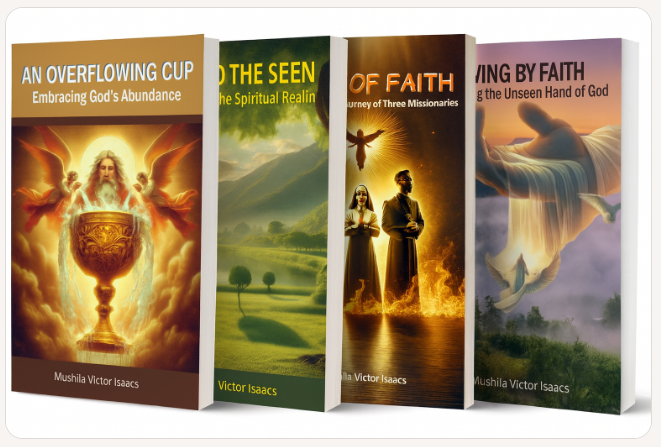
    1. Legacy of Faith: The Unbreakable Journey of Three Missionaries

    Three lives. Three callings. One unshakable faith.

    2. Living by Faith: Trusting the Unseen Hand of God

    Faith is not sight—it is trust in God’s unseen hand.

    3. An Overflowing Cup: Walking by Faith, Living in Abundance

    God’s abundance is not measured in wealth but in grace.

    4. Beyond the Seen: Discovering the Spiritual Realm

    Faith opens our eyes to realities beyond the physical.

    Publishing & Sale Details

    • Price per title (full rights transfer): KES 80,000
    • Rights included: Manuscript, book cover, ISBN (if needed)
    • Option: Sponsorship or donation to publish all four under Mushila Writes

    More Info

    These books are more than manuscripts—they are testimonies of faith, perseverance, and God’s abundance.

    “Faith is tested in fire, but it shines brightest in darkness.” – Mushila Victor Isaacs

    IYF FREE WEEKEND ACADEMY

    IYF Free Weekend Academy: Empowering Nairobi Youth

    Over 30 courses every Saturday & Sunday – Completely Free

    The International Youth Fellowship (IYF) Free Weekend Academy provides practical skills for Nairobi youth, preparing them for jobs, entrepreneurship, and personal growth. Cohort 8 welcomed nearly 20,000 participants in February 2025, including exciting new courses in Driving, English, and Artificial Intelligence.

    🌍 Overview

    • Organizer: International Youth Fellowship (IYF)
    • Partners: Ministry of Youth Affairs, Creative Economy and Sports, Nairobi City County
    • Venue: IYF Headquarters, Off Thika Road, behind Safari Park Hotel, next to USIU
    • Schedule: Saturdays & Sundays
    • Cost: Free of charge

    📚 Courses Offered

    Select a day to see courses available:

    Course Name Category Day
    Graphics DesignDigital & Creative SkillsBoth
    Web DevelopmentDigital & Creative SkillsBoth
    PhotographyDigital & Creative SkillsBoth
    Public SpeakingProfessional SkillsBoth
    LeadershipProfessional SkillsBoth
    EntrepreneurshipProfessional SkillsBoth
    DrivingTechnical SkillsSaturday
    Electrical InstallationTechnical SkillsBoth
    CarpentryTechnical SkillsBoth
    English LessonsLanguage & CommunicationSunday
    KiswahiliLanguage & CommunicationBoth
    Communication ModulesLanguage & CommunicationBoth
    Artificial IntelligenceEmerging FieldsBoth
    Digital MarketingDigital & Creative SkillsBoth
    Social Media ManagementDigital & Creative SkillsBoth
    Video EditingDigital & Creative SkillsBoth
    3D AnimationDigital & Creative SkillsBoth
    Networking BasicsProfessional SkillsBoth
    TeamworkProfessional SkillsBoth
    Conflict ResolutionProfessional SkillsBoth
    Project ManagementProfessional SkillsBoth
    Basic AccountingProfessional SkillsBoth
    Microsoft OfficeTechnical SkillsBoth
    Networking & IT SupportTechnical SkillsBoth
    Creative WritingLanguage & CommunicationBoth
    Critical ThinkingProfessional SkillsBoth
    Customer ServiceProfessional SkillsBoth
    Financial LiteracyProfessional SkillsBoth
    Entrepreneurial SimulationsProfessional SkillsBoth
    Robotics BasicsEmerging FieldsBoth
    AI Coding FundamentalsEmerging FieldsBoth

    📞 Contact & Registration

    Start Your Journey Today

    Join the IYF Free Weekend Academy to gain practical skills, leadership, and employability.

    👉 Register now at wecanacademy.iyfkenya.org

    NYOTA FUNDS, AND REGISTRATION GUIDE

    Nyota Funds Guide for Form Four Graduates

    Apply • Register • Plan • Start a Business • Become Self-Reliant

    Completing Form Four (KCSE) is not the end—it is the beginning. The Nyota Fund (NYOTA Project – National Youth Opportunities Towards Advancement) supports young people to start businesses through grants, training, and mentorship.

    What Is the Nyota Fund?

    • ✔ Government of Kenya youth empowerment program
    • Non-repayable grants (up to KES 50,000)
    • ✔ Business training, mentorship & savings support
    • ✔ Targets youth with Form Four education and below

    Who Can Apply?

    • ✔ Kenyan citizen
    • ✔ Aged 18–29 years (up to 35 for PWDs)
    • ✔ Completed Form Four or below
    • ✔ Valid National ID
    • ✔ SIM card registered in your own name

    How to Apply as an Individual (Step-by-Step)

    Step 1: Ensure your National ID matches your SIM card.
    Step 2: Dial *254# on your phone.
    Step 3: Select NYOTA Project.
    Step 4: Enter your personal and education details.
    Step 5: Submit and wait for SMS confirmation.

    How to Apply as a Group

    • ✔ Form or join a registered Youth Group or SHG
    • ✔ At least 70% of members must be youth
    • ✔ Agree on one income-generating idea
    • ✔ Apply using *254# and provide group details
    • ✔ All members must have valid National IDs

    How to Register a Business Name (Sole Proprietorship)

    Requirements

    • ✔ National ID
    • ✔ Active eCitizen account
    • ✔ Proposed business name
    • ✔ Small registration fee (paid online)

    Procedure

    Step 1: Visit the eCitizen portal and log in.
    Step 2: Select Business Registration Service (BRS).
    Step 3: Apply for name search and registration.
    Step 4: Pay the fee and submit.
    Step 5: Download your certificate.

    How to Register a Self Help Group (SHG)

    Requirements

    • ✔ Minimum of 10 members
    • ✔ Group constitution
    • ✔ Members’ National IDs
    • ✔ Minutes approving registration
    • ✔ Registration fee

    Procedure

    Step 1: Draft and adopt a constitution.
    Step 2: Hold a meeting and record minutes.
    Step 3: Visit the Sub-County Social Development Office.
    Step 4: Submit documents and pay the fee.
    Step 5: Receive your SHG certificate.

    Nyota Simple Business Plan

    Fill this online to guide your application.

    ⚠ IMPORTANT:
    Nyota application and registration are FREE. Do not pay brokers or download unofficial apps. Official application is via *254# only.

    Your Future Starts Now

    Register your business or SHG, complete your plan, apply for Nyota Funds, and begin your journey to self-reliance.

    👉 Dial *254#
    👉 Plan early
    👉 Share this guide with fellow Form Four graduates

    From Passion to Profit: Turning Writing into Sustainable Income in 2026

    From Passion to Purpose: Storytelling for Climate Resilience in 2026 | MushilaWrites

    Across Africa, climate change and environmental degradation are reshaping lives. Communities are being forced to adapt, migrate, or confront the loss of livelihoods. While technical solutions exist, cultural narratives and youth-led storytelling remain underutilized tools for resilience.

    Through Mushila Writes , literature becomes more than art—it becomes a civic instrument. By blending tradition, spirituality, and lived experience, storytelling reframes climate mobility not as defeat, but as dignity, agency, and hope.

    Project Goal

    The goal is to use literature and storytelling as catalysts for climate resilience and migration awareness, equipping vulnerable communities and youth with narratives, tools, and safe spaces to manage climate mobility with dignity. This work builds on themes explored in books such as Whispers of Nature .

    Stories do not merely document movement—they teach us how to stay, how to move, and how to endure.

    Core Objectives

    • Amplify Voices: Document lived experiences through books published on MushilaWrites Books.
    • Educate & Engage: Facilitate youth-led reading circles and workshops, supported by resources on the MushilaWrites Blog.
    • Bridge Cultures: Translate selected works into Kiswahili and local languages.
    • Action-Oriented Storytelling: Pair literature with community initiatives such as tree planting and mentorship.

    Key Activities

    • Monthly literary climate circles across six African communities.
    • Expansion of MushilaWrites.com into a digital hub for climate mobility resources.
    • Youth mentorship and storytelling advocacy training.
    • Community action projects inspired by book themes.
    • Translation of selected titles for wider accessibility.

    Expected Results

    • Six communities engaged through literary climate circles.
    • Thirty youth leaders trained in civic storytelling.
    • Three books adapted into Kiswahili and French.
    • Climate mobility resources hosted online for public access.

    Sustainability Beyond Funding

    Sustainability is built into the model. Books remain in circulation through platforms such as Goodreads and Amazon, while proceeds are reinvested into ongoing community projects.

    Alignment with IOM Climate Mobility Priorities

    This initiative aligns with the International Organization for Migration (IOM) programme on Accelerating Youth-Led Action in Addressing Climate Mobility in Africa, supporting youth-led CSOs and vulnerable communities.

    Mushila Writes is pursuing partnerships and grants that support youth-led climate resilience through storytelling.

    Explore the work at MushilaWrites.com

    © 2026 MushilaWrites.com · Storytelling for climate resilience · All rights reserved
    Whispers of Nature: 100 Poems on Climate and EnvironmentWhispers of Nature: 100 Poems on Climate and Environment by Mushila Victor Isaacs
    My rating: 5 of 5 stars

    Mushila Victor Isaacs’ collection, “Whispers of Nature,” is a profound journey through the subtle and powerful voices of the natural world. Each poem is a carefully crafted reflection on our environment, climate, and the delicate balance of life around us. The work evokes not only admiration for nature’s beauty but also a deep sense of responsibility to protect it.

    What stands out most is Isaacs’ ability to blend poetic imagery with urgent environmental awareness. The poems feel both personal and universal, speaking to readers across generations. Whether you are a nature enthusiast, a poet, or someone seeking inspiration, this book offers a compelling reminder of our connection to the Earth.

    By the end, you are not just reading poems—you are listening to nature’s whispers, and you feel moved to act. A beautiful, enlightening, and timely collection that deserves to be read and shared widely.

    View all my reviews

    The Hidden Wisdom in African Proverbs

    Lessons for Modern Life

    African proverbs carry generations of wisdom, distilled into short, memorable sayings. They are more than words—they are life lessons that guide behavior, decision-making, and relationships. In a rapidly changing world, these ancient teachings remain surprisingly relevant.

    1. Proverbs as Guides for Daily Life

    African proverbs often offer practical advice:

    “Wisdom does not come overnight.” — This teaches patience and the value of experience.
    “Even the best cooking pot will not produce food.” — Success requires effort, not just tools.

    By applying these insights, we can navigate challenges more thoughtfully.

    2. Leadership Lessons

    Many proverbs highlight qualities of great leaders:

    “A leader who does not listen will not lead for long.” — Emphasizes the importance of empathy and active listening.
    “He who learns, teaches.” — True leaders share knowledge, uplifting others.

    African wisdom reminds us that leadership is about service, humility, and vision.

    3. Strengthening Relationships

    Proverbs also guide interpersonal dynamics:

    “If you want to go fast, go alone; if you want to go far, go together.” — Collaboration and community matter.
    “Even the lion protects its cubs from danger.” — Family and responsibility are sacred.

    These timeless lessons help us nurture stronger personal and professional relationships.

    4. Embracing Resilience

    Many African sayings teach resilience and perseverance:

    “Smooth seas do not make skillful sailors.” — Challenges shape character.
    “Rain does not fall on one roof alone.” — Everyone faces struggles, so empathy and persistence are key.

    By embracing these lessons, we cultivate inner strength and adaptability.

    Conclusion

    African proverbs are more than cultural artifacts—they are living guides for modern life. By reflecting on these words of wisdom, we can lead with integrity, nurture meaningful relationships, and navigate life’s challenges with patience and resilience.

    Which African proverb inspires you the most? Share it in the comments below and let’s explore the wisdom of our ancestors together!

    The Tree That Refused to Fall

    A Kenyan Story of Resilience

    In the heart of rural Kenya, beyond the dusty roads and golden landscape, stood an old mugumo tree. For generations, the people of Bwichina Village believed the tree was blessed — a symbol of strength that had sheltered travelers, witnessed droughts, and survived storms that swept through the hills.

    To the villagers, the mugumo was more than a tree. It was a silent elder, a reminder that no matter how harsh the season, life always finds a way to endure.

    The Storm That Tested Everything

    One night, a fierce storm rolled in. The sky cracked with lightning, the wind roared like a hungry beast, and rain fell in violent waves. By sunrise, many trees lay broken and scattered.

    But the mugumo tree still stood.

    Its bark was wounded, its branches bent low — but its roots were deep.

    The Lesson of the Mugumo Tree

    When the villagers gathered around the tree, the elders spoke words that would stay with the young for years:

    “Strength is not the absence of struggle. Strength is surviving what tried to break you.”

    The mugumo taught them that resilience is built quietly — in the days when no one is watching… in the moments when we choose not to give up… in the nights when storms seem endless.

    How This Story Speaks to Us Today

    Life can knock us down with unexpected storms — financial hardships, broken dreams, sickness, betrayal, or days when nothing seems to work. But like the mugumo tree:

    • We can bend, but we do not have to break.
    • We can hurt, yet still rise again.
    • We can endure hard seasons knowing brighter ones are coming.

    Resilience is not about being perfect. It is about holding on just long enough for the storm to pass.

    Root Yourself Deeply

    What kept the mugumo standing was not its height… but its roots.

    In the same way, if you root yourself in:

    • faith,
    • discipline,
    • community,
    • patience,
    • and hope…

    …no storm will permanently destroy you.

    Your Story Isn’t Over

    Every challenge you face is shaping you into someone stronger, wiser, and more grounded. Just like the mugumo, you are allowed to bend, cry, pause, and heal — but never forget: You were created to stand tall.

    Storms will come and go, but your purpose remains.

    Final Thought

    Whenever life feels overwhelming, remember the tree that refused to fall. Stand firm. Hold your ground. Believe in your roots. Your breakthrough may be only one sunrise away.


    Read More from Mushila Writes

    © Mushila Writes — Words that kindle hope.

    Building the Future from Plastic

    Building the Future from Plastic: Kenya’s Youth Leading the Green Revolution | MushilaWrites

    Kenya’s Youth Leading the Green Revolution

    By Mushila Victor Isaacs — Published Nov 5, 2025

    Kenya’s youth are rewriting the story of waste — transforming discarded plastic into bricks of change, innovation, and resilience. This initiative combines climate action, local jobs and community infrastructure. Read more ↓

    What is the Plastic Waste-to-Bricks Initiative?

    The Plastic Waste-to-Bricks Initiative partners with youth and women-led groups to collect, sort and repurpose non-biodegradable plastics into high-quality eco-bricks used for non-load-bearing walls, pavements and landscaping. Each eco-brick uses up to 30% post-consumer plastic and diverts waste from waterways and open burning.

    Project Vision

    Build a circular, low-carbon economy where discarded bottles become building blocks for cleaner cities and livelihoods.

    • Reduce plastic waste in pilot communities by 60%.
    • Train 1,000+ youth & women in production and enterprise skills.
    • Construct 10 eco-learning centres using recycled bricks.

    Why it matters

    With Kenya producing over 1.3 million tonnes of plastic annually (NEMA), and recycling rates under 10%, the opportunity to transform pollution into prosperity is urgent and scalable.

    This model tackles plastic pollution, youth unemployment and urban blight in one community-driven intervention.

    “So let us gather in the tree’s vast shade,
    To honor the legacy creation made.
    For the last standing tree, in its silent stand,
    Is a testament to life, and the soul of the land.”

    “Let’s plant new seeds, let’s water with care,
    Let’s grow a new forest, just and fair.
    For in the last standing tree, there’s a dream to weave—
    Of a world reborn, for all to believe.”

    Project Impact & Metrics

    Indicator2025 TargetOutcome Projection
    Plastic waste diverted500 tons/yearCleaner streets & restored rivers
    Youth trained1,200 individuals~75% gain self-employment
    Green jobs created300 permanent rolesImproved local livelihoods
    CO₂ reductions (est.)1,000 tons/yearLower urban air pollution

    🧭 SWOT Analysis

    StrengthsWeaknesses
    Low-cost, locally appropriate tech; youth-driven; high social impactInitial capital for presses & drying racks; quality-control training needed
    OpportunitiesThreats
    Partnerships with NGOs & funders; SDG alignment; local market demandPolicy uncertainty; fluctuation in recyclable plastic supply

    Research & Credibility

    Key references and data sources we use to model the project:

    Voices from the Field

    Mary, Kibera (22) — “We’re not just cleaning up; we’re building our future — one brick at a time.”

    Amina, Makueni (34) — runs a women’s group that supplies 200kg of plastic monthly and uses proceeds to pay school fees.

    Joseph, Kisumu (19) — moved from casual labour to production lead after two months of training.

    How You Can Help (Download / Donate / Partner)

    🔗 Related Posts

    Share this story — help us turn plastic into opportunity.

    Keywords: eco-bricks, plastic waste Kenya, youth empowerment, circular economy, MushilaWrites

    Farmers Preserving Africa’s Agro-Heritage for a Greener Tomorrow

    Farmers Preserving Africa’s Agro-Heritage | MushilaWrites

    Farmers Preserving Africa’s Agro-Heritage

    The Untold Stories of Women Protecting Seeds of Tomorrow

    By Mushila Victor Isaacs
    Author of Whispers of Nature – 100 Poems on Climate and Environment


    Introduction: Seeds of Memory, Seeds of Hope

    Across Africa, a quiet revolution is sprouting in the hands of women farmers. Beneath the golden sun of the savannahs and the fertile soils of the highlands, they are preserving the seeds of ancient crops — a living heritage that binds generations to the earth.

    In a time when industrial farming and climate change threaten indigenous biodiversity, these women stand as guardians of an ancestral wisdom — protectors of Africa’s agro-heritage. Through storytelling, seed exchange, and traditional farming, they keep alive a resilient ecosystem that nourishes both people and planet.

    As Wangari Maathai once said:

    “When we plant trees, we plant the seeds of peace and hope.”
    Today, women farmers are doing the same — planting seeds of continuity, identity, and sovereignty.


    The Essence of Agro-Heritage

    Agro-heritage refers to the collective knowledge, seeds, and farming practices passed down through generations. It embodies the cultural and ecological memory of African communities.

    According to the Food and Agriculture Organization (FAO), smallholder farmers — most of them women — produce nearly 80% of Africa’s food supply, yet remain the least supported. Their role in preserving native crops like sorghum, millet, cowpeas, and cassava is essential to food security and cultural survival.

    These farmers are not merely cultivators; they are custodians of living archives. Each seed they save carries the DNA of resilience — resistant to drought, pests, and the unpredictable weather patterns of a warming world.


    Storytelling the Soil: Three Voices of Preservation

    1️⃣ Mama Njeri — The Seed Keeper of Murang’a

    At 62, Mama Njeri has kept over 40 indigenous seed varieties in her small clay pots. She recalls her grandmother saving seeds after every harvest — drying them on woven mats under the sun.

    “I keep them because they remember who we are,” she says, holding a handful of brown millet. Her seed library has now become a local teaching center for girls in her village. Every seed she gives away is a story passed on — a legacy reborn.

    2️⃣ Fatuma — The Desert Farmer from Wajir

    In the arid north, Fatuma turns scarcity into survival. Her family lost their cattle to drought, but through community training she began cultivating hardy indigenous crops such as sorghum and pigeon peas.

    Supported by a UNEP adaptation project, her farm now thrives on organic manure and solar-powered irrigation. Fatuma’s cooperative supplies local markets with drought-resistant grains — feeding more than 200 families.

    3️⃣ Grace — The Seed Sister of Busia

    Grace leads a women’s collective that exchanges indigenous seeds across counties. Through a simple “seed bank” model, she preserves varieties like black-eyed peas and traditional maize. “These are our insurance policies against hunger,” she smiles. Her group now collaborates with agricultural students to document seed traits and climate performance.


    📊 Benefits and Research Indicators

    According to FAO’s 2023 Food Security Report, communities that integrate indigenous crop systems experience:

    • 🌾 30–50% higher crop resilience during droughts compared to imported hybrid seeds.
    • 🥦 Up to 25% increase in dietary diversity among households using mixed indigenous crops.
    • 🌍 Significant soil restoration through organic inputs and crop rotation.

    Similarly, a World Bank study emphasizes that investing in women farmers could increase agricultural yields in Africa by up to 20–30%, strengthening both livelihoods and ecosystems.


    SWOT Analysis

    Strengths Weaknesses
    Deep local knowledge and seed diversity Limited access to modern preservation tools and funding
    Opportunities Threats
    Partnerships with universities, NGOs, and international seed networks Loss of indigenous knowledge due to youth migration and commercialization

    💰 Funding & Sustainability Models

    This initiative can be scaled through grants and partnerships such as:

    These collaborations offer financial, training, and networking support to sustain grassroots efforts. Communities can also create micro-seed banks and small agribusiness units for organic produce and seed sales.


    🌎 Global Relevance & Alignment with SDGs

    This project contributes directly to:


    📚 Related Posts


    💬 Call to Action: Be a Seed Keeper

    Start your own seed story. Collect indigenous seeds from your community, exchange with local farmers, document the process, and share it on MushilaWrites Blog. Use the hashtag #SeedsOfTomorrow.

    📥 Download Full Project Proposal (PDF)
    “Each time a seed is saved, a story is told — and a future is secured.”
    — Mushila Victor Isaacs