Empowering Women and Youth Through Eco-Briquettes in Africa

Turning Waste into Worth — Empowering Women and Youth Through Eco-Briquettes | MushilaWrites.com

🌿 Turning Waste into Worth

By Mushila Victor Isaacs
Author of Whispers of Nature – 100 Poems on Climate and Environment

Where Change Begins

In the heart of Africa’s low-income communities, hope often germinates from the soil of necessity. Beneath the cries for better livelihoods and the smoke of dwindling forests lies a story waiting to be rewritten — a story of empowered women, inspired youth, and communities redefining sustainability.

At MushilaWrites.com, we believe that storytelling and action go hand in hand. Through projects like the Eco-Briquette Training and Production Hubs and Kitchen Garden Initiative, we are transforming waste into opportunity while restoring dignity and healing the planet.

This initiative aligns with the United Nations Sustainable Development Goals (SDGs) — particularly SDG 1 (No Poverty), SDG 5 (Gender Equality), SDG 7 (Affordable and Clean Energy), SDG 13 (Climate Action), and SDG 15 (Life on Land).

Studies by the United Nations Environment Programme (UNEP) and the World Bank show that transitioning from charcoal to eco-briquettes can reduce indoor air pollution by up to 70% and save approximately 10–12 trees per ton of briquettes produced. Similarly, the Food and Agriculture Organization (FAO) highlights that briquette technology can reduce rural energy poverty while promoting sustainable livelihoods.

Eco-briquette demonstration Food and Agriculture Organization (FAO) highlights that briquette technology can reduce rural energy poverty while promoting sustainable livelihoods.

What Are Eco-Briquettes — and Why They Matter

Eco-briquettes are compressed blocks of organic waste — rice husks, maize cobs, sawdust, coffee husks, and sugarcane bagasse — turned into clean-burning, smoke-free fuel. They replace charcoal and firewood, repurposing agricultural waste while reducing methane emissions.

  • Reduce deforestation
  • Lower household air pollution
  • Create sustainable income streams
  • Mitigate climate change

“So let us gather in the tree’s vast shade,
To honor the legacy creation made.
For the last standing tree, in its silent stand,
Is a testament to life, and the soul of the land.”

“Let’s plant new seeds, let’s water with care,
Let’s grow a new forest, just and fair.
For in the last standing tree, there’s a dream to weave—
Of a world reborn, for all to believe.”

~ The Last Standing Tree Poem.

The Project Concept: Turning Waste into Worth

  • Project Title: Turning Waste into Worth — Empowering Women and Youth Through Eco-Briquettes
  • Location: Bungoma, Kakamega, Machakos, Makueni, and Nairobi informal settlements (Pilot Phase)
  • Duration: 6 months (expandable to 24 months)
  • Beneficiaries: 10 women and youth directly; ~500 households indirectly
  • Partners: Mushila Writes Environmental Initiative, UNEP, and Laudato Si’ Movement

Project Overview

The Eco-Briquette Training and Production Hub empowers women and youth to convert agricultural waste into clean energy — creating green entrepreneurs while promoting sustainability.

Key Components:

  1. Training and Capacity Building
  2. Production and Distribution
  3. Entrepreneurship and Marketing
  4. Community Awareness through storytelling

🌾 Practical Training: Teaching 10 Women and Youth

In Kakamega, ten locals gather under a mugumo tree, learning to turn maize husks into clean energy. Through workshops, participants gain skills to produce and sell eco-briquettes — earning from sustainability and healing their environment.

Environmental and Social Impact

Impact AreaExpected Outcome
Deforestation Reduction1 ton of briquettes saves 12 trees annually.
Air Pollution ReductionIndoor smoke reduced by 60–70%.
Income Generation$50–$120/month per participant.
Waste Management2+ tons of waste repurposed monthly.
Community Awareness500+ people reached through outreach.

SWOT Analysis

StrengthsWeaknesses
Locally available materials; strong community support.High initial equipment cost.
Inclusive women/youth model.Limited awareness of technology.
OpportunitiesThreats
Partnerships with UNEP, Laudato Si’, local governments.Market competition from charcoal/LPG.
Expansion to schools and institutions.Climate extremes affecting raw supply.

💰 Project Budget (6-Month Pilot)

ItemDescriptionCost (USD)
Training MaterialsBriquette molds, protective gear800
Training WorkshopVenue, facilitation, meals600
EquipmentManual presses, drying racks1,200
Awareness CampaignFlyers, videos, social media500
Seed CapitalStarter kits for trainees1,000
Monitoring & EvaluationField visits and data tracking400
Admin & LogisticsCoordination and communication500
Total$5,500

Funding and Partnership Opportunities

🧩 Storytelling & Community Engagement

Storytelling is our bridge between action and awareness. Explore related stories:

Be Part of the Movement

Join us in turning waste into worth, despair into dignity, and forests of tomorrow into legacies of today.

Partner or Donate Today

“Let’s plant new seeds, let’s water with care,
Let’s grow a new forest, just and fair.”
— The Last Standing Tree, Mushila Victor Isaacs

The Third World War May Not Be Fought with Bombs—But with Droughts, Floods, and Fire

In the shadow of history’s bloodiest conflicts, a quieter war is brewing—one that threatens every border, every faith, and every future. From the trenches of World War I to the ashes of World War II, humanity has battled over territory, ideology, and power. But the next great war may erupt not from politics, but from planetary collapse.

From Trenches to Tipping Points: A Historical Prelude

  • World War I (1914–1918) was ignited by nationalism, imperial ambitions, and the assassination of Archduke Franz Ferdinand. The scramble for colonies and resources intensified tensions among European powers.
  • World War II (1939–1945) followed unresolved grievances, economic despair, and the rise of fascism. Hitler’s expansionism and the failure of appeasement plunged the world into chaos.

Today, the battleground is shifting. The enemy is no longer a nation—it’s climate disruption. The weapons? Deforestation, fossil fuels, and political apathy.

Climate: The New Catalyst of Conflict

In a recent global summit, President Donald Trump remarked on the evolution of climate discourse: “First it was global cooling, then warming, now it’s climate change. What’s next?” His words, though controversial, reflect a growing confusion—and urgency—around environmental instability.

But this isn’t just semantics. Climate change is already:

  • Displacing millions through floods and droughts
  • Fueling resource wars over water, land, and food
  • Triggering migration crises and geopolitical instability (UNHCR report)

UNEP warns that without radical action, climate-induced disasters could spark violent conflicts, especially in vulnerable regions like the Sahel, Amazon, and coastal Asia.

A Moral Call from the Vatican

At the Raising Hope for Climate Justice conference, Pope Leo XIV stood before a melting glacier and declared:

“God will ask us if we have cultivated and cared for the world that He created… What will be our answer?”

He echoed the legacy of Pope Francis, whose encyclical Laudato Si’ called for “integral ecology”—a fusion of environmental stewardship and social justice.

“The earth, our home, is beginning to look more and more like an immense pile of filth.” —Pope Francis

This is not just theology. It’s a moral imperative.

MushilaWrites: Voices of Resistance and Renewal

Victor Isaacs Mushila’s trilogy—Whispers of Nature, The Earth Defenders, and When Rivers Rebel—offers poetic prophecy and grassroots wisdom. These works, featured on MushilaWrites.com, are more than literature—they’re climate testimony.

They connect African resilience with global urgency, bridging UNEP’s policy frameworks with Vatican reflections and youth-led advocacy.

The Third World War: A Climate Reckoning

If the first two world wars were fought over borders, the third may be fought over biospheres. Expect:

  • Water wars in drought-stricken regions
  • Climate refugees challenging national policies
  • Eco-terrorism and sabotage of extractive industries
  • Digital activism and poetic resistance

This war won’t be televised—it will be lived. And it’s already begun.

🕊️ Final Word: From Crisis to Covenant

We are one family, with one Father, inhabiting one planet. As Pope Leo XIV said, “We must care for it together.” Let MushilaWrites be your compass in this unfolding storm—a platform where poetry meets policy, and where advocacy becomes action.

Visit MushilaWrites.com and share this post. Let’s make it reach 1000+ hearts on Awstart—and beyond.

Support Climate Advocacy
— Victor Isaacs Mushila
www.mushilawrites.com

Empowering Youth & Protecting the Environment in Kakamega County

Empowering Youth & Protecting the Environment in Kakamega County | Mushila Writes

Transforming Waste into Opportunity: Eco-Youth Initiative in Kakamega County

Empowering youth, women, and communities through sustainable environmental projects.

Why Kakamega County Needs Change

Kakamega County faces persistent youth unemployment, environmental degradation, and limited access to vocational skills. Many young men turn to illicit brews like chang’a for income, while women and marginalized groups shoulder the burden of unstable households. The Eco-Youth Initiative, based in Masingo, Kakamega County, offers an ethical, sustainable solution that merges job creation with environmental restoration.

Introducing the Eco-Youth Initiative

This groundbreaking project transforms human waste into biogas, organic fertilizers, and compost, providing youth and women with marketable skills, sustainable income, and ethical alternatives to unsafe and illicit livelihoods. Beyond economics, the initiative promotes community awareness, hygiene, and environmental stewardship.

Key Benefits:

  • Employment for over 200 youth and 500 indirect jobs.
  • Clean energy through biogas for local households.
  • Production of organic fertilizers, improving soil fertility and local agriculture.
  • Reduction in water pollution and CO₂ emissions (~150 tons/year).
  • Empowerment of women, girls, and persons with disabilities.

Connect With Mushila Writes Environmental Works

To understand the depth of environmental advocacy in Kakamega and beyond, explore these works by Mushila Writes:

Global Funding Opportunities & Partnerships

The Eco-Youth Initiative is aligned with global priorities and welcomes collaboration with NGOs, donors, and corporate partners committed to youth empowerment, women’s empowerment, and environmental sustainability. Key partners and funding sources include:

Get Involved – Apply, Invest, or Donate

You can be part of this transformative journey:

Final Thought

The Eco-Youth Initiative is more than a project—it’s a movement. By transforming waste into energy and organic wealth, we uplift communities, empower youth, and restore the environment. Your involvement—through funding, partnership, or advocacy—will catalyze change that resonates from Kakamega County to global sustainability networks.

Start making a difference today: Join the Eco-Youth Initiative and support a greener, ethical, and prosperous Kakamega County.

Poetry, History, Social Justice, and Environmental Wisdom Books

Top African Books for Environmental & Social Justice Readers – MushilaWrites

Top African Books for Environmental & Social Justice Readers

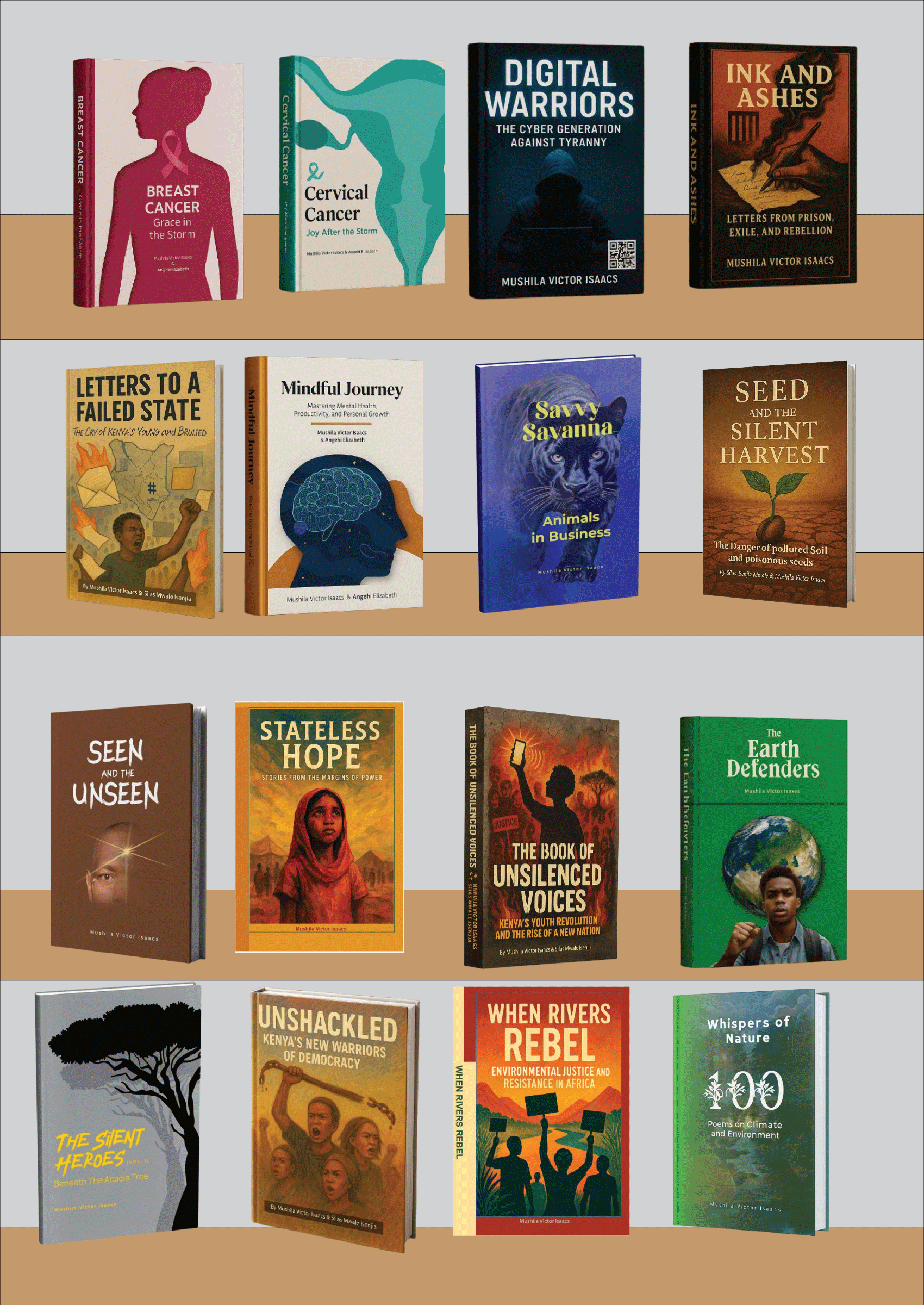
16 Inspiring Works by Mushila Victor Isaacs – Poetry, History, Social Justice, and Environmental Wisdom

If you’re looking for powerful African literature that blends environmental awareness, history, business insights, and social justice, these 16 top books by Mushila Victor Isaacs are a must-read. Perfect for students, NGOs, youth, and global readers seeking inspiration and action.

1. Whispers of Nature

A poetic journey celebrating nature’s beauty and urging readers to protect our planet. Perfect for schools, activists, and poetry lovers.

Read More Buy on Amazon

2. Seen and the Unseen

A suspense-filled novel exploring life’s mysteries, cultural struggles, and the tension between appearances and reality. Ideal for fiction lovers and students of African spirituality.

Read More Buy on Amazon

3. Savvy Savanna: Animals in Business

A business guide inspired by African wildlife teaching resilience, leadership, and adaptability. Great for entrepreneurs and students of business.

Read More Buy on Amazon

4. The Silent Heroes: Beneath the Acacia Tree

Historical novel spotlighting Kenya’s unsung heroes during the Mau Mau rebellion. Engaging for literature students and history enthusiasts.

Read More Buy on Amazon

5. The Earth Defenders

A rallying call to protect the planet from climate threats, injustice, and exploitation. Ideal for NGOs, schools, and environmental activists.

Read More Buy on Amazon

6. When Rivers Rebel

Stories of African communities rising against environmental degradation and injustice. Perfect for scholars and activists.

Read More Buy on Amazon

7. Stateless Hope

Explores displacement and exile, giving voice to marginalized communities left behind by politics and bureaucracy.

Read More Buy on Amazon

8. Ink and Ashes

Letters from prison and exile exploring resilience, rebellion, and hope during challenging times.

Read More Buy on Amazon

9. Digital Warriors

Examines digital activism and the role of technology in the fight for freedom. Ideal for youth and tech enthusiasts.

Read More Buy on Amazon

10. Breast Cancer: Grace in the Storm

An empowering guide to navigating breast cancer with courage and faith. Perfect for patients, healthcare workers, and women’s organizations.

Read More Buy on Amazon

11. Cervical Cancer: Joy After the Storm

Messages of hope and empowerment for cervical cancer survivors and their families. Ideal for women’s health NGOs.

Read More Buy on Amazon

12. Mindful Journey

Practical reflections and strategies for mental health, productivity, and personal growth. Suitable for youth, professionals, and counselors.

Read More Buy on Amazon

13. Letters to a Failed State

Collection of letters from Kenya’s youth expressing frustration, resilience, and hope. Engaging for political students and activists.

Read More Buy on Amazon

14. The Book of Unsilenced Voices

Chronicles the courage and determination of Kenya’s youth in their push for justice and democracy. Perfect for NGOs and youth movements.

Read More Buy on Amazon

15. Seeds of the Silent Harvest

An urgent call to address environmental and agricultural threats in Africa. Ideal for farmers, NGOs, policymakers, and schools.

Read More Buy on Amazon

16. Unshackled

Stories of Kenya’s new generation of freedom fighters challenging corruption and injustice. Perfect for youth, university students, and civic groups.

Read More Buy on Amazon
Buy All Books on Amazon

© 2025 MushilaWrites. All rights reserved.